





















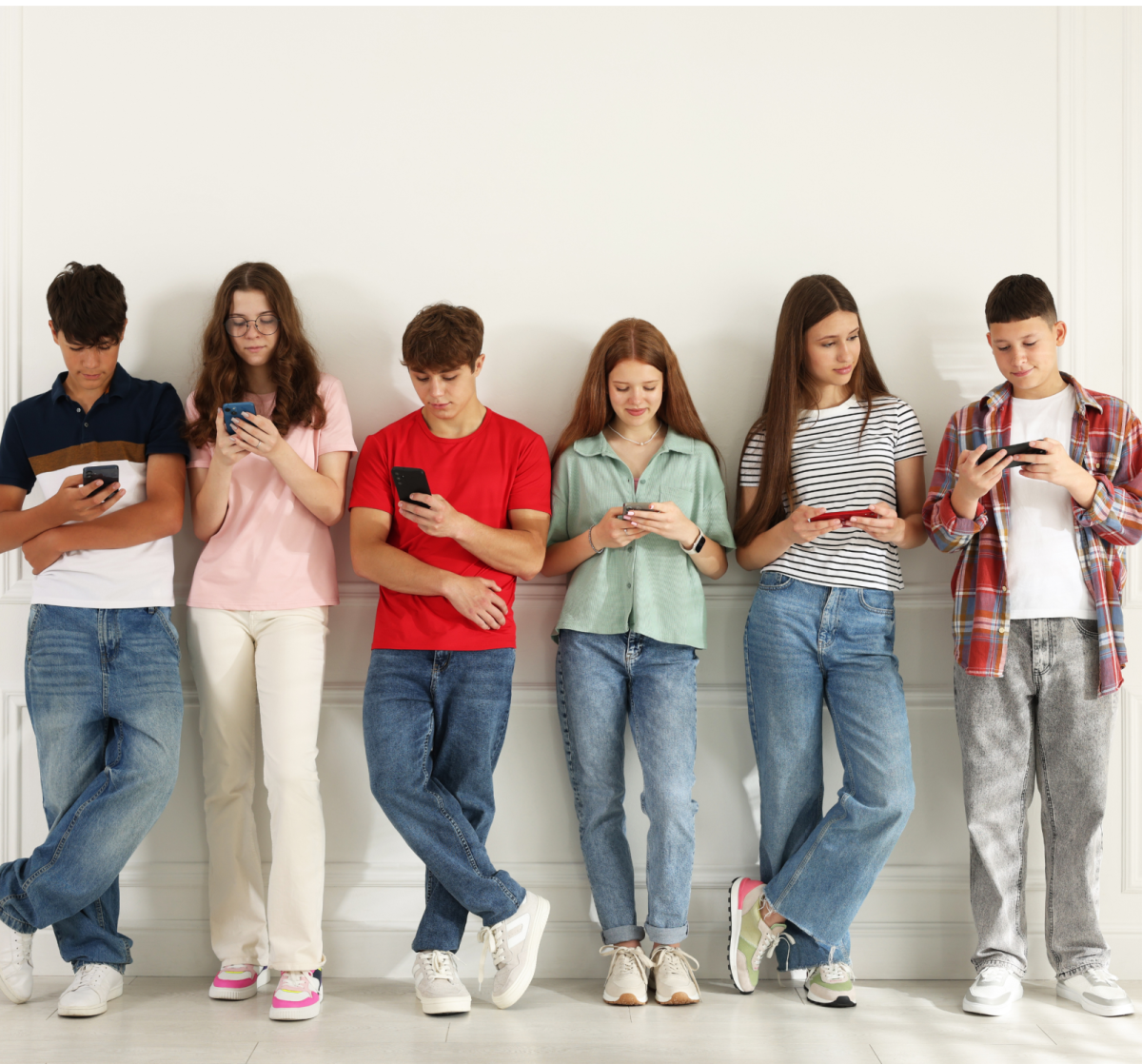
If you’ve ever opened TikTok “for just five minutes,” only to check the clock and realize it’s suddenly an hour later and you’ve learned absolutely nothing except a dance trend or the newest brain-rotting terminology, you’re not alone. For many students, constant notifications, short-form videos, and multitasking between homework and social media have become a typical ritual in everyday life. However, some researchers are beginning to question whether this digital lifestyle may be affecting Gen Z’s ability to focus and learn.
Recent research suggests that Gen Z’s attention span has been shrinking. A 2015 Microsoft study found that the average attention span is around eight seconds… four whole seconds shorter than millennials, and more importantly, shorter than a goldfish. Researchers attribute this change largely to constant exposure to fast-paced digital content and multitasking across multiple screens.
For years, each generation has been projected to surpass the one before it academically. However, recent research suggests that this may no longer be the case. According to neurologist Dr. Jared Cooney Horvath, Generation Z – those born between 1997 and 2012 – may be the first generation in modern history to show signs of declining academic performance compared to the previous generation.
“They’re the first generation in modern history to score lower on standardized academic tests than the one before it,” Horvath said in an interview with the New York Post. Even more concerning, Horvath noted that students have “underperformed on basically every cognitive measure, from basic attention, memory, literacy, numeracy, executive function, and general IQ.”
Experts believe the shift may be tied to a dramatic change in how young people consume information. Today’s students have grown up with smartphones, social media, and constant digital stimulation. As the first generation of true digital natives, Gen Z has spent most of their lives consuming information through short videos, scrolling, and notifications. This environment trains the brain to expect quick bursts of information rather than extended periods of concentration. According to Horvath, “More than half of the time a teenager is awake, half of it is spent staring at a screen.” While technology has made more information accessible than ever before, it may also be changing the way students process information to maintain focus.
Horvath explains that learning historically relied more deeply on interaction and extended concentration. “Humans are biologically programmed to learn from other humans and from deep study, not flipping through screens for bullet point summaries,” said Horvath. Instead of carefully reading and analyzing information, many students now briefly skim short pieces of content online.
To see whether these trends appear locally, a survey of 15 Lake Travis High School students was conducted about their technology habits and attention spans. These results reflect many of the same concerns experts have raised.
When asked about daily phone usage outside of their schoolwork, 80% of students reported spending more than three hours per day on their phones, with one third of the respondents reporting over seven hours of daily screen time. At the same time, 95% of students admitted to multitasking on their phones while completing homework, which can make it difficult for their brains to fully concentrate on one task.
Many students also shared that they feel their attention spans have declined. Nearly three out of four respondents (73%) reported that their ability to focus has decreased over the past three years. Four students said their attention span had significantly decreased, while seven said it had slightly decreased.
Students themselves pointed to technology as a possible cause. One respondent wrote, “With the rise of scrolling and short-form content, thinking and expectations for activities have become more fast-paced and less attentive.” Another student said that the way teens approach challenges has changed, explaining that “we tend to look toward someone or something else for an answer if we don’t immediately know the solution.”
Artificial intelligence and other online tools were also mentioned as factors that influence how students think and learn. One student explained that “any tough questions can easily be solved with the use of AI and other solving apps.” While these tools can be helpful, they may also reduce the need for deeper problem-solving and critical thinking.
Despite these concerns, some students pointed out that technological change is not entirely negative. One respondent noted that every generation experiences shifts in how people learn and communicate, saying, “society has always adapted to new forms of technology and information.”
Still, Horvath believes the trend should be taken seriously. In testimony before lawmakers, he warned that declining cognitive performance could have long-term consequences. “A sad fact our generation has to face is this: Our kids are less cognitively capable than we were at their age,” he said. Historically, each generation has improved academically compared to the previous one – “until Gen Z.”
Maybe the real challenge for Gen Z isn’t whether we’re “getting dumber,” but whether we can learn to pause the scrolling long enough to truly focus. Easier said than done, especially when there’s always another notification waiting. But if there is one thing this generation is talented at, it is adapting.
And maybe the first step is putting the phone down… at least until this article is finished!