























For decades, Americans were taught from a very early age that whole grains should form the foundation of a healthy diet and that fats should be limited. This month, the federal government reversed that message.
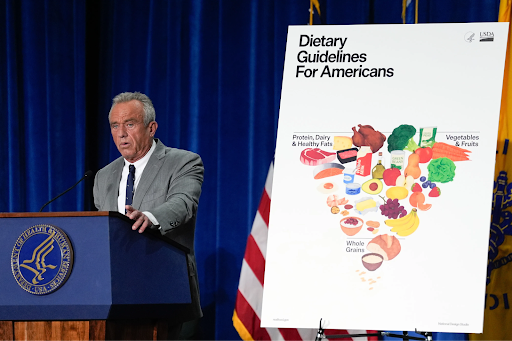
Health and Human Services Secretary Robert F. Kennedy Jr. announced a restructured food pyramid that prioritizes protein rich foods, dairy products, fruits, vegetables, and healthy fats, while visually minimizing grains. This change replaces the Obama-era “MyPlate” food diagram introduced in 2011, and reflects a larger shift in how federal leaders view nutrition, chronic disease, and personal health responsibility.
Kennedy framed the new update to the food pyramid at a press conference as corrective to past government policy, calling it “the most significant reset on nutrition policy in history,” and arguing that earlier guidelines discouraged foods that support metabolic health. Kennedey also said that “Protein and healthy fats are essential and were wrongly discouraged in prior dietary guidelines,” and declared an end to what was described as “the war on saturated fats.”
This decision is more than a new graphic design, it is a policy move with broad reaching consequences. Federal dietary standards guide food purchasing for the military, school cafeterias, and government nutrition initiatives. As a result, the food pyramid redesign may influence what millions of Americans eat on a daily basis, including students.
From a public health perspective, the updated model promotes cutting back on carbohydrates and highly processed foods, while prioritizing whole foods. Supporters argue that this approach could help reduce obesity and metabolic disease, especially as processed foods dominate grocery stores and fast food menus.
Researchers also point out evolving evidence surrounding dairy consumption. Cardiologist and nutrition scientist Dariush Mozaffarian said “It’s pretty clear that overall milk and cheese and yogurt can be part of a healthy diet,” noting that both low fat and whole fat options have been associated with lower cardiovascular risk.
However, the guidelines have grown concerns from medical and nutrition organizations caution against increased saturated fat intake. “I’m very disappointed in the new pyramid that features red meat and saturated fat sources at the very top, as if that’s something to prioritize. It does go against decades and decades of evidence and research,” said Christopher Gardner, a nutrition expert at Stanford University. Groups such as the American Heart Association, for example, continue to recommend limiting saturated fat due to its relation to heart disease.
The new model has also raised questions about its clarity. While grains appear minimized in the pyramid image, the written guidelines still encourage Americans to prioritize fiber filled whole grains. Experts worry that the visual image may oversimplify nuanced nutritional science, leading to public confusion. Beyond questions of clarity, the redesign also reflects a larger ideological shift within federal health leadership. Kennedy’s recent health alterations cannot be separated from their conservative political context.
However, it is also important to contextualize Kennedy’s most recent health reforms, as their conservative political backdrop is impossible to ignore. These efforts make up his larger “Make America Healthy Again” movement.
This extension of President Trump’s “Make America Great Again” campaign is often criticized for its demotion of vaccine research. For example, Kennedy ordered the removal of all 17 members of the CDC Vaccine Advisory Committee in June 2025. Shortly after, he hand-picked new members of the committee that more closely aligned with his political goals.
In an even more drastic change, Kennedy’s new committee voted to reduce the recommended childhood vaccine schedule from 17 shots to 11. The six removed immunizations included RSV, Hepatitis B, and meningitis. Supporters of the new vaccine schedule agree with Kennedy’s belief that it will rebuild public trust in federal health recommendations.
However, because Kennedy has promoted the debunked notion that vaccines are related to autism, critics question the credibility of his seemingly anti-vaccination politics. Kennedy has also previously expressed support of dietary practices that disregard decades worth of research and government recommendations.
For example, NBC News highlights his support of the consumption of raw milk. Although this belief is personal rather than an explicit part of his “Make America Healthy Again” initiative, the FDA has discouraged and condemned the consumption of raw milk since the 1980s. While the Raw Milk Institute believes in its immune-boosting properties, the FDA cites years’ worth of research proving that raw milk tends to foster bacteria and foodborne illnesses. For these reasons, pasteurized milk is the safest option for the American public.
Kennedy’s disproven beliefs about vaccinations and dietary health have caused his new food pyramid to garner skepticism. Although protein and whole foods are undeniably important aspects of a healthy diet, those opposed to Kennedy’s new food pyramid question his credibility in light of his other claims.
As the revised food pyramid begins to influence schools, government programs, and household choices, its long term impacts remain uncertain. Whether changes lead to improved public health or further confusion may depend less on the graphic itself and more on the public’s trust in the science and leadership behind it.